When founders think about raising capital, the conversation usually centers around valuation, ownership, and access to funding.
But one of the most consequential questions is rarely asked:
Is this the right capital for the business we are trying to build?
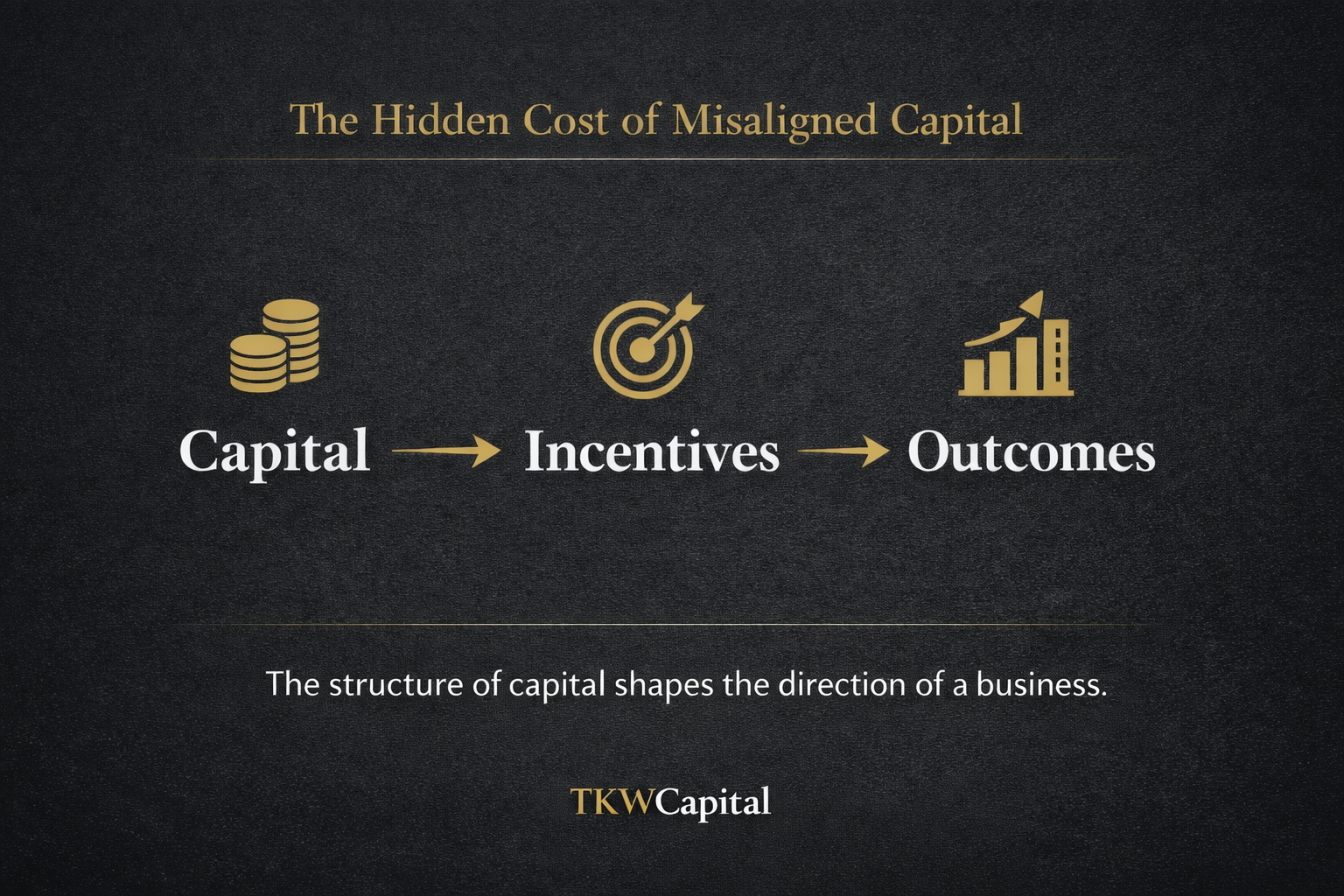
Capital is never neutral.
Every dollar carries with it assumptions, expectations, and time horizons. Those forces quietly shape the decisions founders make long after the investment is wired.
When capital is aligned with the mission and strategy of a company, it becomes a powerful catalyst for durable growth.
When it is misaligned, the consequences often surface slowly — but they can fundamentally alter the direction of the business.
Understanding the hidden cost of misaligned capital is one of the most important disciplines for founders and long-term investors alike.
Capital Always Comes With a Time Horizon
Every capital partner has a timeline.
Venture funds often operate within 7–10 year fund cycles.
Private equity firms may be targeting 3–5 year exits.
Public markets frequently reward quarterly performance.
None of these structures are inherently wrong. They simply reflect how the capital itself is structured.
The challenge arises when a business with a long-term mission is financed with short-term capital expectations.
When this happens, founders begin to experience subtle but powerful pressure:
- Growth decisions driven by exit timelines
- Strategic initiatives designed to maximize valuation rather than durability
- Operational priorities shaped by investor reporting cycles
Over time, the company can drift away from the original vision that made the business worth building in the first place.
Misaligned Capital Quietly Changes Decision-Making
Few founders intend to compromise their long-term vision.
But incentives matter.
When investors require liquidity within a specific window, leadership teams naturally begin optimizing for what must happen before that window closes.
That shift can manifest in ways such as:
- Accelerating expansion before the company is operationally ready
- Prioritizing revenue growth over healthy margins
- Avoiding investments that take longer to mature
- Structuring the company for sale rather than endurance
None of these decisions are inherently wrong. In many situations they may even be appropriate.
But when they are driven by capital pressure rather than business fundamentals, they can introduce risk that compounds over time.

The Real Cost Often Appears Years Later
The effects of misaligned capital are rarely immediate.
In the early stages, capital solves real problems:
- hiring key leaders
- investing in infrastructure
- accelerating growth
But as time progresses, the incentives embedded in the capital structure begin to surface.
Founders may find themselves facing decisions that feel increasingly uncomfortable:
- Selling earlier than originally planned
- Restructuring leadership to prepare for exit
- Shifting strategy to maximize valuation metrics
At that point, the path of the company is often already set.
This is why capital alignment must be evaluated before the investment is made, not after.
The Best Capital Partners Understand Stewardship
Not all capital is purely transactional.
Some investors approach capital with a philosophy closer to stewardship than extraction.
Stewardship-oriented investors tend to prioritize:
- Long-term value creation
- Durable business models
- Leadership stability
- Healthy organizational culture
Rather than asking only “How quickly can this investment be realized?”, the conversation becomes:
“What kind of enterprise should this business become over time?”
This shift in perspective can dramatically change the strategic posture of a company.
When founders and investors share a long-term horizon, leadership teams gain the freedom to:
- invest in systems that strengthen the company
- develop people and culture
- build resilience into the business model
- pursue opportunities that compound over decades
These are the kinds of decisions that build enduring enterprises.
Capital Is More Than Funding — It Is Influence
Every investment relationship creates influence.
Investors sit on boards, shape strategy conversations, and influence the metrics that leadership teams prioritize.
This influence is not inherently problematic — in fact, strong investors can be extraordinarily valuable partners.
But founders should recognize that the source of their capital will influence the direction of the company.
Questions worth considering include:
- What time horizon does this capital operate within?
- How do these investors define success?
- What type of businesses do they typically build?
- Do they prioritize quick exits or durable enterprises?
These questions often reveal far more about a capital partner than the valuation discussion.
Choosing Capital Is One of the Most Strategic Decisions a Founder Makes
Raising capital is often framed as a financial event.
In reality, it is a strategic partnership decision that can shape the trajectory of the company for years to come.

The right capital partner can provide:
- patient support during difficult seasons
- strategic insight during moments of growth
- alignment around the long-term purpose of the business
The wrong capital structure, however, can slowly redirect the company toward outcomes that were never part of the original vision.
This is the hidden cost of misaligned capital.
Building Businesses That Endure
Great companies are rarely built overnight.
They are shaped through years of disciplined decision-making, careful capital allocation, and leadership committed to the long-term health of the enterprise.
Capital that shares this perspective can be a powerful ally.
Capital that does not may still produce financial returns — but it often does so by prioritizing speed over durability.
For founders and investors who care about building businesses that endure, the question is not simply:
“Can we raise capital?”
It is:
“Is this the kind of capital that will help us build the enterprise we believe should exist?”
Because the structure of capital does more than fund a business.
Over time, it helps determine what that business ultimately becomes.
A Conversation Worth Having
Founders often spend significant time evaluating valuation, deal terms, and ownership structure.
Far fewer spend time thinking about whether the capital itself is aligned with the kind of business they want to build.
Those conversations are worth having early.
At The Kingdom Way Capital, we spend much of our time thinking about how capital structures influence the long-term health of companies and the people who lead them.
If you are navigating decisions around growth, ownership, or capital partners, we’d love to connect.
No pressure. Just perspective.