
Capital doesn’t just reshape strategy. It reshapes the decisions you make before you even realize a decision is being made.
Most conversations about capital focus on the big moments. The raise. The structure. The terms. What happens after the deal closes.
The more interesting question, and the one we’ve come to believe matters most over time, is what happens to the small ones.
Capital doesn’t just influence where a business goes. It quietly reshapes how it operates day to day. The decisions that feel routine. The ones that seem obvious. The ones that get made so quickly, nobody stops to ask whether they’re being made differently than they were before. We’ve seen this pattern enough times that it’s become one of the first things we look for.

The hiring decision
Before capital, hiring decisions tend to be deliberate. You wait until the need is undeniable. You hire when the business has truly earned it.
After capital, that math quietly changes. There’s runway. There’s pressure to deploy it. A hire that would have waited three months gets made in three weeks. Not because the need became clearer, but because the context shifted.
We’ve watched this happen in businesses we know well. The hire wasn’t wrong on paper. It made sense given the resources available. What changed was the reasoning behind it, and that shift matters more than most people realize.
The pricing decision
Pricing is one of the most revealing places capital shows up, because it exposes what the business is actually optimizing for.
A founder building without external pressure tends to price around conviction. What does this relationship deserve? What reflects the value we’re creating? What do we want to be known for?
A founder building with a timeline, with investors, with growth expectations, with the weight of capital that needs to be justified, often prices differently. Sometimes more aggressively. Sometimes more defensively. Either way, the calculation has changed, even if the price looks the same on paper. We’ve sat across the table from founders who couldn’t articulate why their pricing had drifted, only that it had.
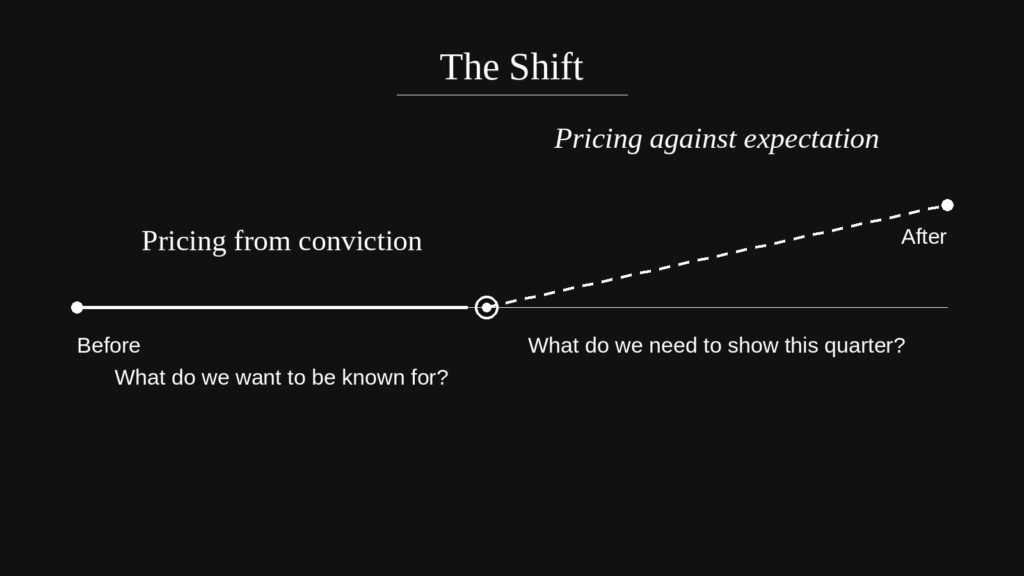
The faster win vs. the better one
This is one of the subtler shifts, and one of the most consequential.
Every business faces moments where there are two paths forward. One is faster, more visible, easier to point to. The other takes longer, requires more patience, but builds something more durable.
Without capital pressure, the choice often comes down to what the founder actually believes is right. With it, something else enters the room. The faster win starts looking better. Not because it is better, but because it’s easier to justify. Easier to report on. Easier to defend.
We’ve seen businesses drift significantly over two or three years by consistently making this trade. No single decision stands out. The pattern only becomes visible in hindsight, and by then it’s much harder to correct.

The investment that doesn’t show immediate return
Long-term investments in people, in infrastructure, in relationships are the ones that compound most quietly. They rarely show up in the next quarter’s numbers. They’re hard to attribute. Easy to defer.
When capital is present, deferring them becomes easier to rationalize. There’s always something more urgent. Something with a clearer short-term return. Something that’s easier to show.
What gets deferred tends to stay deferred. What gets skipped in the name of short-term performance tends to show up later as something that costs significantly more to fix, or that simply never gets built at all. We’ve watched this play out more times than we’d like to count.
What this means for how capital is structured
None of this is an argument against capital. It’s an argument for being intentional about what kind of capital you take, and what it’s implicitly asking you to optimize for.
Capital always asks for something. Sometimes it’s explicit: targets, timelines, milestones. More often it’s not. It shows up in what gets attention. What gets questioned. What gets rewarded. Slowly, quietly, those signals start to shape decisions long before anyone acknowledges that a shift has happened.
This is exactly why we built tKWCapital the way we did. Buy, grow, hold. Not as a tagline, but as a structural commitment to staying aligned with founders on the decisions that actually matter, not just the ones that are easy to measure.
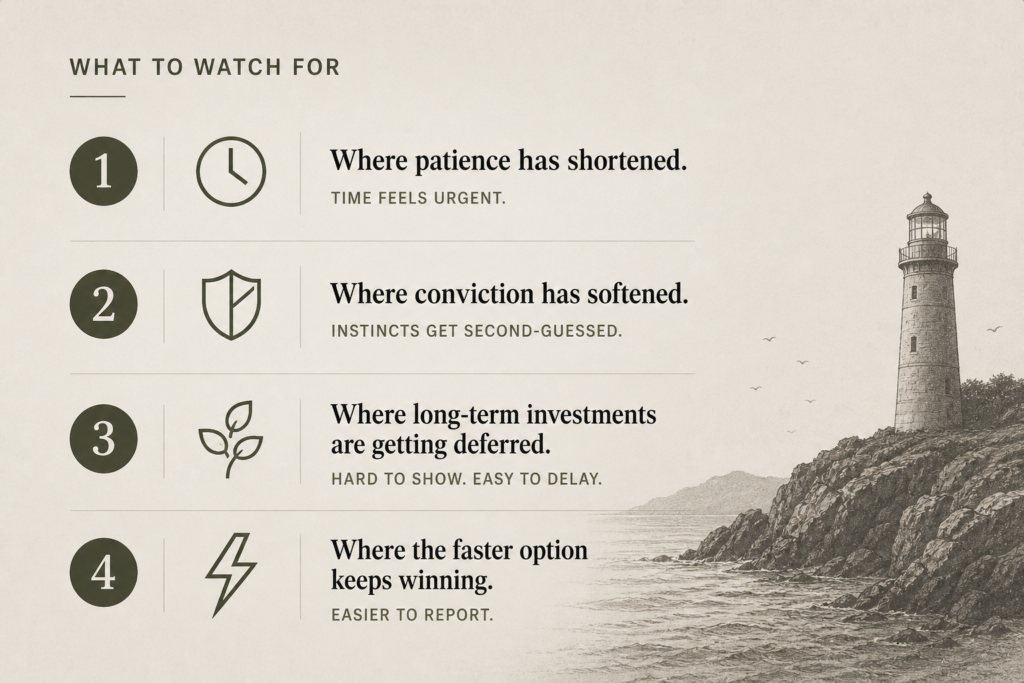
The founders who navigate this well aren’t the ones who avoid capital. They’re the ones who stay clear about what they’re optimizing for, and who choose partners whose definition of stewardship matches their own.
That alignment doesn’t happen by accident. It happens before the deal closes, in the conversations most people don’t think to have.
If you’re in the middle of thinking through those questions, we’re always open to having that conversation.
Schedule a call to talk with a member of our team.