One of the difficult aspects of owning a business is realizing that the plan you started with may no longer be the right plan. We’re about nine months into a turnaround with one of our acquisitions, and the business today looks different from the one we expected to own when we closed.
We know considerably more now than we did then. We’ve seen how customers respond, what the business actually requires to operate, where the team is strong and where it isn’t, and which of our original assumptions haven’t held up. Some of these have been difficult to accept, but they’ve also given us information we simply didn’t have when we made the acquisition.
At some point, I think an owner has to stop asking, “How do we make the original plan work?” and start asking, “Knowing what we know today, what is the right path forward?”
There’s an important difference between these two questions.
The Original Thesis Has a Powerful Pull
Every acquisition begins with a story about what the business could become. You study the company, build the model, identify the opportunity and develop a thesis around where you believe you can create value. By the time you actually own the business, you’ve probably spent months reinforcing that thesis, not only to yourself, but often to your partners, lenders, leadership team and everyone else involved in getting the deal done.
That creates a certain amount of commitment to the original plan, and commitment is usually a good thing. Businesses need owners who are willing to stay with a strategy long enough to see whether it works. If you change direction every time something becomes harder than expected, you probably won’t give many good ideas enough time to succeed.
But there’s another risk on the other side of that. You can become so committed to proving the original thesis that you stop evaluating whether it still makes sense. New information gets interpreted through the old plan, problems become obstacles that simply need to be overcome, and you can find yourself working harder and investing more to make reality conform to the business you expected to own.
That’s something I’ve had to consider with this acquisition. Am I still pursuing the best opportunity in front of us, or am I trying to prove that what I originally believed was right? There’s an important difference between the two.
Changing the Plan Doesn’t Necessarily Mean the Investment Was Wrong
I think owners can sometimes treat the original investment thesis as a pass-or-fail test. Either the business becomes what we expected it to become, or the acquisition was a failure. The more time I spend operating businesses, the less convinced I am that it’s always that simple.
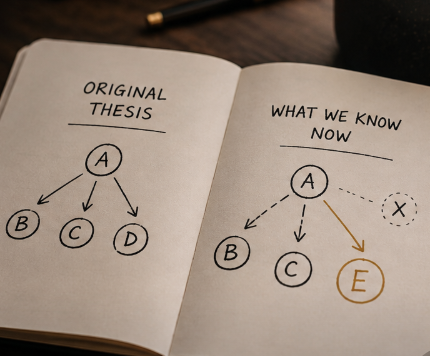
A business can disappoint you in one area and surprise you in another. The growth opportunity you expected may not materialize, but another one might. A customer segment you thought would be important may turn out not to be, while a capability you didn’t fully appreciate going in becomes more valuable once you’re actually operating the company. Sometimes what you learn after owning a business changes not only your expectations, but your understanding of where its real opportunity is.
That doesn’t mean every struggling business contains some hidden opportunity if you just keep looking for it. Sometimes the economics simply don’t work. But before reaching that conclusion, I think it’s worth separating two questions: Is the original plan still viable, and is there still a valuable business here?
Those aren’t necessarily the same question, and treating them as if they are can keep an owner focused on rescuing a strategy rather than evaluating the business itself.
Turnaround and Reinvention Aren’t the Same Thing
That distinction has also made me think differently about what we mean when we call something a turnaround. A turnaround generally assumes there is something you’re trying to restore. Revenue needs to recover, margins need to improve, costs need to come down or operations need to become more disciplined. You have some idea of what a healthy version of the company looks like, and the work is about getting the business back there.
Reinvention is different because it asks whether the company you’re trying to restore is actually the company that should exist going forward. Maybe the customer has changed. Maybe the competitive landscape has changed. Maybe the company’s strongest capabilities point toward a different opportunity than the one you originally saw. Or maybe, once you’re inside the business, you realize that the positioning you originally believed in simply doesn’t create enough value.
If that’s true, working harder on the turnaround may not solve the bigger problem. You can improve operations, cut expenses and execute every item on the plan while still avoiding the more important question of whether you’re building the right business in the first place.
That’s a distinction I’m trying to be conscious of right now. There’s no shortage of activity when a company is struggling. The challenge is determining which activity is actually moving the business toward something worth building.
Conviction Has to Leave Room for New Information
I believe conviction matters in business. There are plenty of moments when the numbers aren’t moving quickly enough, other people don’t see what you see, and the easiest decision would be to abandon something before it has had a real opportunity to work. If you change your mind every time the market pushes back, you probably won’t build much of anything meaningful.
But conviction can’t mean refusing to update your thinking. The information I have nine months into owning a company is fundamentally different from the information I had on closing day, and that information should have some influence on the decisions I make now.
One question I’ve found useful is whether I would make the same decision today knowing everything I now know. If the answer is no, that doesn’t automatically mean we should walk away from the business. But I do think I need to understand why the answer has changed.
Maybe the long-term opportunity is still there and the path is simply harder than we expected. Maybe the strategy needs to change. Maybe the business needs to become something different from what we originally envisioned. Or maybe what we’ve learned tells us that continuing isn’t the right decision.
I don’t think there’s a formula that makes that determination easy. But as our understanding of the business changes, our decisions have to be allowed to change with it. Holding onto an assumption simply because we believed it nine months ago isn’t conviction if the evidence is now pointing us somewhere else.
What Would You Build If You Were Starting Today?
This may be the question I’ve found most useful in thinking through where we go from here: If we were starting with this company today, what would we build?
For a moment, take away the original presentation, the acquisition model, the plans made before closing and everything that has already been tried. Look instead at the business that actually exists today. Who would we serve? What would we want to be known for? Where would we invest? What would we stop doing? What kind of team would the business actually need?
And then there’s an even harder question: Would we choose to own this business today?
Obviously, you don’t get to truly start over. History matters. Employees matter. Existing commitments matter. The capital already invested is real, and so are the consequences of whatever decision comes next. But mentally starting from zero can be a useful exercise because it exposes how much of the current strategy is based on what you believe about the future and how much of it is being carried forward simply because of decisions you’ve already made.
If I were evaluating this company for the first time today, with everything I now know about it, what would I see as the opportunity? That answer may be more useful than continually asking how to get back to what we thought the opportunity was nine months ago.
The Goal Isn’t to Prove the Original Thesis
There’s an ego component to this that I don’t want to ignore. As owners, we make decisions and then naturally become attached to them. We hired the person. We approved the strategy. We bought the company. We told people why we believed in the opportunity. Changing direction can feel like admitting that we got something wrong.
Sometimes we did.
I think there’s a certain amount of humility required in that admission. It’s easy to talk about being willing to change course when the original decision belonged to someone else. It’s much harder when you were the one who made the call, believed in the opportunity and convinced others to believe in it too.
Humility, in this context, is being willing to let new information challenge your own judgment. It’s recognizing that changing your mind doesn’t automatically mean you lacked conviction the first time. It may simply mean you know more now than you did then.
That distinction matters to me. I don’t want to spend the next several years trying to prove that a decision I made nine months ago was right simply because I was the one who made it. I’d rather have the humility to acknowledge where my assumptions were wrong, learn from them and make the best decision I can for the business we actually own today.
That may mean staying the course and giving the original strategy more time. It may mean changing direction, rebuilding an area we thought was already settled or accepting that the best version of this business looks different from the one we originally imagined. And, in some situations, it may mean deciding not to continue at all.
We’re still determining what that means for this particular business, and I don’t know yet where we’ll land. But this experience has changed the way I think about an investment thesis:
The goal isn’t to prove that the original thesis was right. The goal is to have enough humility to see the business as it is today and make the best decision from there.
About tKW Capital
At tKW Capital, we partner with founder-led businesses and invest with a long-term perspective. Our goal is to provide thoughtful capital and partnership that strengthens what has already been built while creating opportunities for the business, its people and the communities around it.
If you’re a business owner thinking about what comes next—whether that’s growth, bringing on a capital partner or eventually transitioning the business—we’d be glad to start a conversation.