
A company can close out a profitable year and still be closer to a serious cash commitment than anyone in the building realizes. Earnings look strong, the bank is comfortable, nobody is worried. But a third of the fleet came off warranty two years ago, a term loan signed when the company was half its size is still running on covenants built for a different balance sheet, and customers are taking longer to pay than they did when the budget was set. Those financial pressures can build long before their full impact becomes apparent on the income statement.
Parts of it are visible on the balance sheet. Not as answers, but as a set of questions an owner would rather ask on their own schedule than on somebody else’s. What the equipment actually needs, when the loan really restricts you and how collectible those receivables are, those answers live in the asset records, the loan agreements and the aging reports behind the statement.
A balance sheet does not forecast the future by itself. What it can do is point to the places where financial commitments form quietly: equipment aging on a schedule nobody is tracking, cash piling up in receivables and inventory, debt terms fixed years ago. The statement records amounts. The questions underneath those amounts are where the real work is, and they require going to the records behind the numbers.
The Cost of Equipment You Already Own
The balance sheet carries property and equipment at accounting values. That tells you how much capital is recorded in the business. It does not tell you how old the trucks actually are, what condition they are in or how much life is left in them.
Depreciation is where owners get misled. It is an accounting allocation, an estimate of how an asset’s cost is spread over its useful life, and it is not an inspection report. A vehicle can be fully depreciated and still running routes every day, or it can be halfway through its depreciation schedule and costing a fortune in repairs. The depreciation line does not know the difference.
So if you want to know what equipment is actually about to cost you, the balance sheet is the prompt and the fixed-asset register is the answer. Purchase dates, maintenance history, usage records and the capital plan will distinguish a truck that is old but serviceable from one that is about to become expensive.
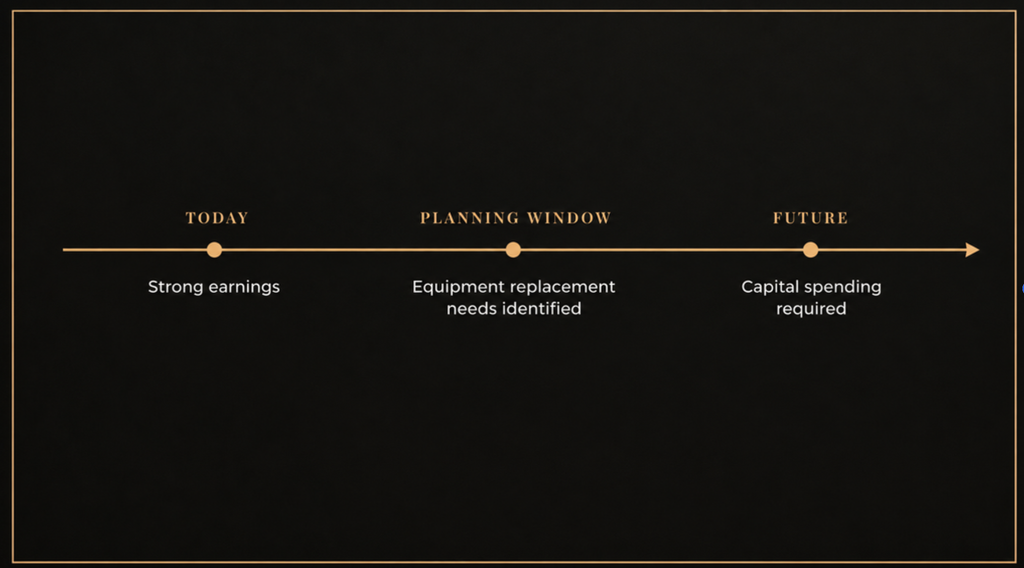
Here is a hypothetical example with some numbers attached. A service company bought vehicles and specialized equipment in several waves, and a large group of vehicles entered service around the same time. Say that group is nine trucks, that a work truck in this trade runs somewhere in the $60,000 to $90,000 range to replace, and that the maintenance records now show rising repair costs on the older units. If only five of the nine end up needing replacement over the next few years, that is roughly $300,000 to $450,000 of capital spending. The other four may run for years yet, since age alone does not decide replacement. Either way, the income statement shows solid profitability and depreciation recorded as expected. Replacing those trucks is a capital expenditure, with the cost generally recorded as an asset and depreciated over time. But the business still needs to fund the purchase, whether through available cash or financing.
And that is the trap. Age alone does not force replacement, and deferring the spending does not remove it. The equipment stays on the books either way. What changes is how much say the owner has over the timing.
Where Your Cash Gets Tied Up
Receivables and inventory sit on the balance sheet as assets. They are not cash, and the gap between the two is where pressure builds. A receivable is only cash once the customer pays. Inventory is only cash once it is sold, and only then if it is still worth selling.
When those balances grow, more of the company’s cash is committed to running the operation, even while revenue and earnings look perfectly healthy. The statement tells you the amounts at a point in time. It does not tell you whether the receivables are collectible or the inventory is usable, and that is the part worth investigating.
The receivables aging, inventory detail and count reconciliations answer the questions the balance sheet raises. Is the money current or is it drifting? Is stock turning, or has some of it quietly become dead weight? The useful question is not whether balances went up. It is what explains the increase and when that paper turns back into cash.
The Commitments That Come With Debt
A debt balance on the balance sheet tells you what is owed on the reporting date. It does not tell you the terms that will shape the next few years of decisions. Those live in the loan documents: repayment schedule, maturity, collateral, and the covenants.
Covenants deserve particular attention, because they are easy to forget and hard to ignore. A covenant can require the business to maintain a financial ratio or limit certain actions. A repayment schedule demands cash on schedule whether or not the company has a better use for it that quarter. Debt is not inherently good or bad. Its effect depends on its cost, its terms and whether the business can generate the cash the agreement assumes.
Again, a hypothetical example. A company borrowed with a term loan when it was half its current size, and the agreement’s covenants were built around that earlier financial profile. Years later the company is doing well and considering an expansion. But the added borrowing or spending could put covenant compliance in question, because the terms were never updated to fit the company the business became. The balance sheet shows the loan exists. Only the agreement, the current covenant calculations and a cash-flow forecast can tell you whether the expansion actually fits inside the constraints. FDIC examination guidance on commercial lending notes that term loans are repaid through business cash flow on a fixed amortization schedule, with covenants among the standard terms.
The pattern repeats. The balance sheet identifies the commitment. The supporting records explain it.
What Buyers, Sellers, and Owners Need to Know
If you are buying a business, this is where diligence starts. The balance sheet helps you identify recorded assets and obligations that need to be tested against supporting schedules and agreements.
If you are preparing to sell, run the same review before a buyer does. It is easier to explain what is recorded, what is owed and what may need investment when you have already looked at it yourself.
And if you are operating, this is not a one-time exercise. Assets age, working capital moves and debt gets repaid or renewed. One reporting date is not a substitute for a current cash forecast. It is one part of a broader picture.
Turning Financial Information Into Better Decisions
A practical review pairs the statement with the records that explain both amounts and timing:
- Equipment: fixed-asset register, purchase and disposal records, maintenance history, usage information and planned capital expenditures.
- Receivables and inventory: aged receivables, detailed inventory reports, count reconciliations and reserves or write-downs.
- Debt: executed financing agreements, repayment schedules, covenant definitions, compliance calculations and renewal dates.
That is really the whole argument of this article. Profitability tells you how the business performed last period. The balance sheet, read alongside the records behind it, tells you what the business may be about to owe for. And the practical advantage of knowing that early is simple. A commitment you see two years out is a planning decision. The same commitment discovered two months out can become a scramble. The earlier you understand what’s coming, the more options you have.
Sources and Further Reading