Most investment portfolios look remarkably similar.
A mix of index funds. A standard allocation model. Maybe a robo-advisor quietly rebalancing in the background. On paper, everything works the way it’s supposed to. The fees are low. The diversification checks out. Progress is being made.
And yet, for many faith-driven investors, something still feels off.
Not because the numbers are wrong — but because the approach feels incomplete.
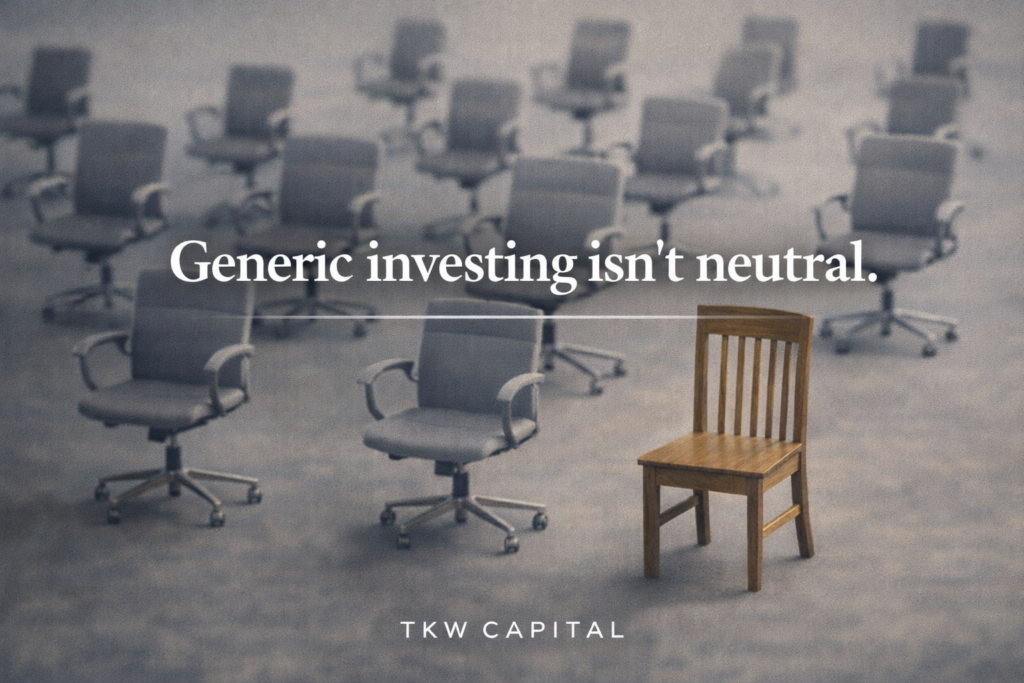
Generic investing isn’t neutral.
It’s a decision to let someone else decide what your capital supports.
For those who view resources as something entrusted rather than owned outright, that realization tends to surface sooner or later.
When Convenience Replaces Intention
Generic investment strategies are designed for scale. They aim to work reasonably well for a very broad audience, across a wide range of beliefs, priorities, and time horizons.
That efficiency is their appeal. It’s also their limitation.
Over time, investors may begin asking different questions:
- What does my capital actually enable?
- Who benefits from the businesses I’m invested in?
- Am I stewarding this intentionally — or simply following a default path?
These aren’t questions of performance alone. They’re questions of responsibility.
Because capital doesn’t just grow quietly in the background. It actively shapes the world it touches.

Seven Observations for Moving Beyond Generic Investing
Rather than prescriptive “steps,” these are patterns we consistently see among investors who take stewardship seriously.
1. Long-Term Ownership Changes Everything
Faith-aligned investors tend to think in decades, not quarters. Patience becomes a strategy. Leadership development becomes an investment. Community relationships deepen because the intent is to stay, not extract.
2. Kingdom-Driven Private Equity Rejects the Extractive Model
Capital can be deployed to strip value — or to create it. Stewardship-driven ownership prioritizes healthy operations, responsible leverage, and outcomes that allow businesses, employees, and communities to flourish together.
3. Employee Flourishing Is a Leading Indicator
People are not line items. When businesses invest in fair wages, meaningful work, growth opportunities, and dignity, they build cultures that outperform over time. This isn’t soft thinking — it’s foundational.
4. Community Impact Is Part of the Equation
Businesses exist in real places. Faith-aligned capital asks what an investment does to the local ecosystem it enters — jobs, suppliers, families, and institutions — not just returns sent elsewhere.

5. Clear Boundaries Matter
Biblical screening isn’t about perfection or judgment. It’s about alignment. Drawing clear lines around what capital will and won’t support reflects conviction — and often prudence over the long run.
6. Patient Capital Weathers Storms Better
Markets move quickly. Stewardship moves wisely. Investors with longer time horizons aren’t forced into bad decisions during downturns. They can adjust, support leadership, and stay the course.
7. Capital Without Wisdom Falls Short
Capital without wisdom is just money. And money alone doesn’t transform businesses.
Faith-aligned investing requires presence — operational insight, mentorship, accountability, and partnership. Stewardship shows up not just in funding, but in walking alongside those building the work.
Why This Matters in the Long Run
Generic investing can perform well for years before deeper questions arise. Faith-aligned stewardship often surfaces later — when investors begin thinking about legacy, transition, and responsibility beyond themselves.
Because at the end of the day, your capital is going to build something.
The only question is: what?
A More Intentional Way Forward
Moving beyond generic investing doesn’t mean abandoning diversification, professional management, or financial discipline. It means refusing to let convenience replace conviction.
At TKW Capital, we work with investors and operators who want their capital to reflect both discipline and purpose — not as a statement, but as a practice.
Because how capital is stewarded shapes more than outcomes.
It shapes people, businesses, and the legacy left behind.
If you’re beginning to ask deeper questions about alignment and responsibility, that’s often the right place to start.
For those who want to explore what faith-aligned stewardship could look like in practice, we invite you to schedule a conversation with our team.
Schedule a call