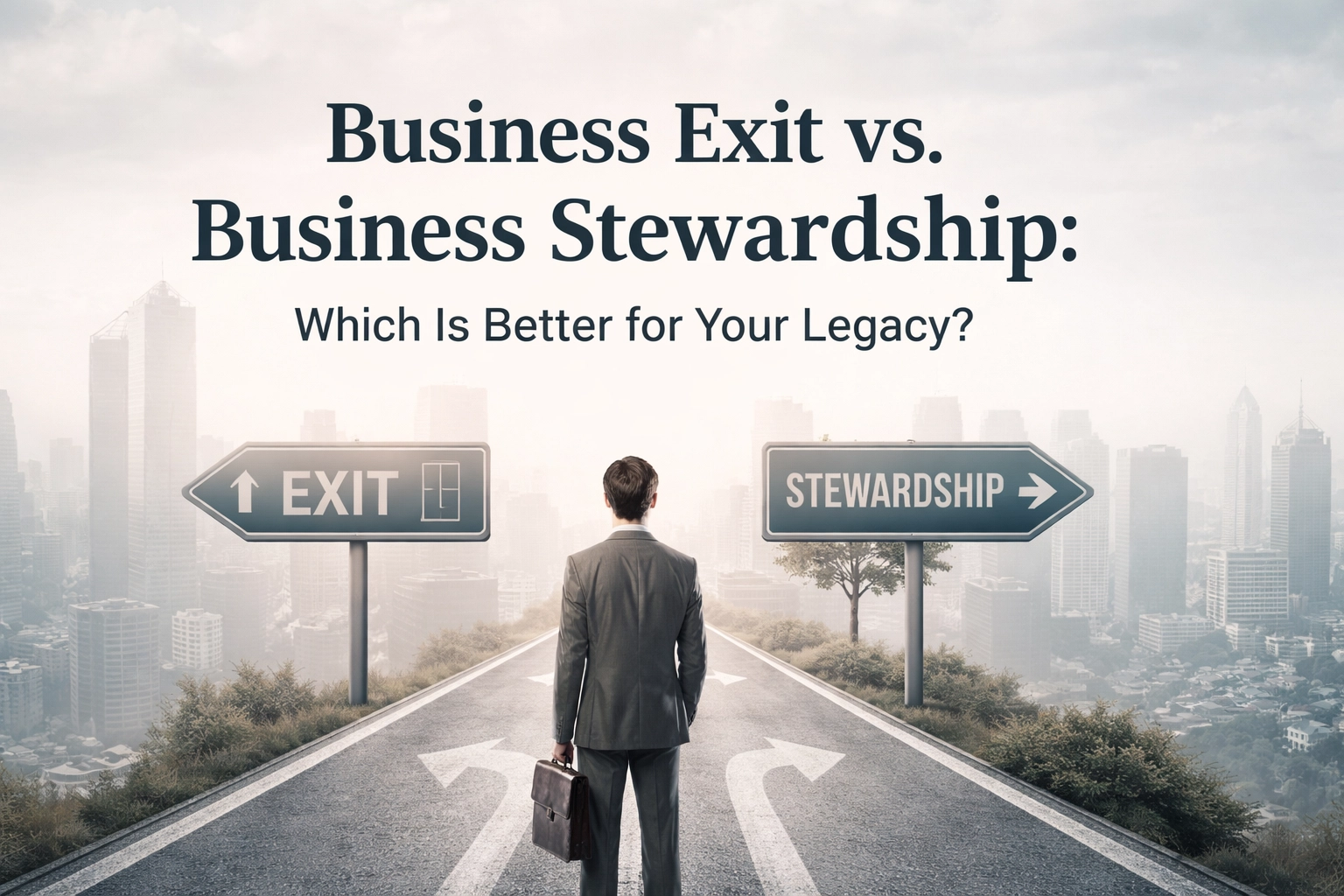
You’ve spent decades building something meaningful. Blood, sweat, sleepless nights, and countless sacrifices have gone into your business. Now you’re facing the question every business owner eventually confronts: what happens next?
What many owners don’t realize until late in the process is this: the way you transition out of your business matters just as much as how you built it—sometimes more.
Conventional wisdom says to maximize your exit. Get the highest multiple, cash out, and move on. But what if the better question isn’t “How much can I get?” but rather “What kind of legacy am I leaving behind?”
The Traditional Business Exit: Quick Liquidity, Uncertain Legacy
Here’s what a traditional business exit often looks like.
You hire an investment banker. Financials are optimized, buyers are sourced—usually private equity or a strategic acquirer—and the goal is to achieve the highest price in the shortest amount of time. Deals move quickly. Papers are signed. The check clears.
On paper, it looks clean.
But we’ve seen what often happens after the transaction closes:
- Company culture is dismantled in the name of efficiency
- Long-term employees are restructured out or replaced
- Values that once guided decisions become secondary to quarterly returns
- Communities lose businesses that once supported local jobs and families
Within a few years, the company you built can become nearly unrecognizable.
The financial outcome may be strong. The long-term impact is often far less certain.
Traditional exits prioritize liquidity over longevity. They’re designed to extract value efficiently. And while financial security matters, it’s worth asking whether this approach fully honors what you spent a lifetime building.

The Stewardship Model: A Different Way Forward
What if, instead of simply exiting your business, you stewarded it into its next chapter?
This question sits at the heart of our work at TKW Capital. We believe business ownership is about more than building wealth—it’s about building something that endures. Something that continues to serve employees, customers, and communities long after ownership changes hands.
Stewardship reframes the conversation. Instead of asking, “How fast can we close this deal?” it asks:
- How do we preserve the culture and values that made this business successful?
- How do we protect the people who helped build it?
- How do we ensure the business continues serving its community?
- How do we honor the founder’s legacy while positioning the company for long-term growth?
Stewardship takes a longer view. It’s not about extracting value—it’s about cultivating it over time.
Why Legacy Deserves Serious Thought
As owners move closer to transition, one truth becomes increasingly clear: money is a tool, but legacy is a testimony.
The business leaders we admire most aren’t remembered for the size of their exit. They’re remembered for the lives they impacted, the standards they upheld, and the institutions they built.
Scripture reflects this broader view. Proverbs 13:22 reminds us that a good person leaves an inheritance for their children’s children—an inheritance that includes not just financial resources, but values, reputation, and example.
When you choose stewardship over a quick exit, you’re making a statement about what matters most. You’re saying that your employees aren’t just line items on a balance sheet. You’re saying that your community isn’t collateral damage in a financial transaction. You’re saying that the way you finish matters just as much as the way you started.
Exit vs. Stewardship: Understanding the Tradeoffs
Neither path is universally right. Context matters. Some owners require liquidity. Others lack succession options. But if you care deeply about what happens after you step away—about the people, the mission, and the community—stewardship deserves thoughtful consideration.
How TKW Capital Approaches Stewardship
At TKW Capital, our investment approach is built around long-term stewardship.
- Long-term ownership mindset: We’re not focused on flipping businesses in three to five years. We acquire companies with the intention of owning and operating them for the long term, which fundamentally changes how decisions are made.
- Values-aligned leadership: We look beyond financial performance to assess alignment—culture, leadership, and mission matter.
- Employee-first operations: People aren’t costs to minimize; they’re assets to develop. We invest in leadership, retention, and sustainable growth.
- Community responsibility: Businesses are embedded in communities, and we take that responsibility seriously.
- Faith-driven principles: Integrity, stewardship, service, and generosity aren’t slogans for us—they’re operating commitments.
Stewardship doesn’t mean growth is slower or decisions are easier. It means growth is intentional and aligned.
Which Path Is Right for You?
Before defaulting to the conventional exit model, it’s worth asking:
- What do I want my business to look like in ten years?
- What happens to my employees after I leave?
- How does my community depend on this business?
- How does my faith inform this decision?
- What do I want to be remembered for?
These aren’t abstract questions. They have real, lasting consequences.
The Bottom Line
A traditional business exit provides a payout. Stewardship builds a legacy.
Both have their place. But in a market where businesses are often treated as assets to be optimized and sold, stewardship offers an alternative—one that allows owners to do well financially while doing good in the process.
At TKW Capital, we partner with business owners who want their life’s work to continue making an impact long after ownership transitions.
If that resonates with you- if you’ve been looking for an alternative to the traditional exit playbook: we’d love to have a conversation. Schedule a call with someone on our team and let’s explore what stewardship could look like for your business.
Because the way you leave matters—and your legacy is worth protecting.