Most founders evaluate the upside. Few evaluate behavior under pressure.
Most founders know how to evaluate a deal.
They compare terms.
They model outcomes.
They think through what growth could look like with the right partner.
What’s less obvious—and far more important—is how to evaluate the partner behind it.
Because most partnerships don’t fall apart because of the deal.
They fall apart because of misalignment that only shows up under pressure.
Early on, things feel aligned. Goals sound similar. Expectations seem clear.
But that alignment is often based on how each side expects things to go—not how they’ll respond when they don’t.
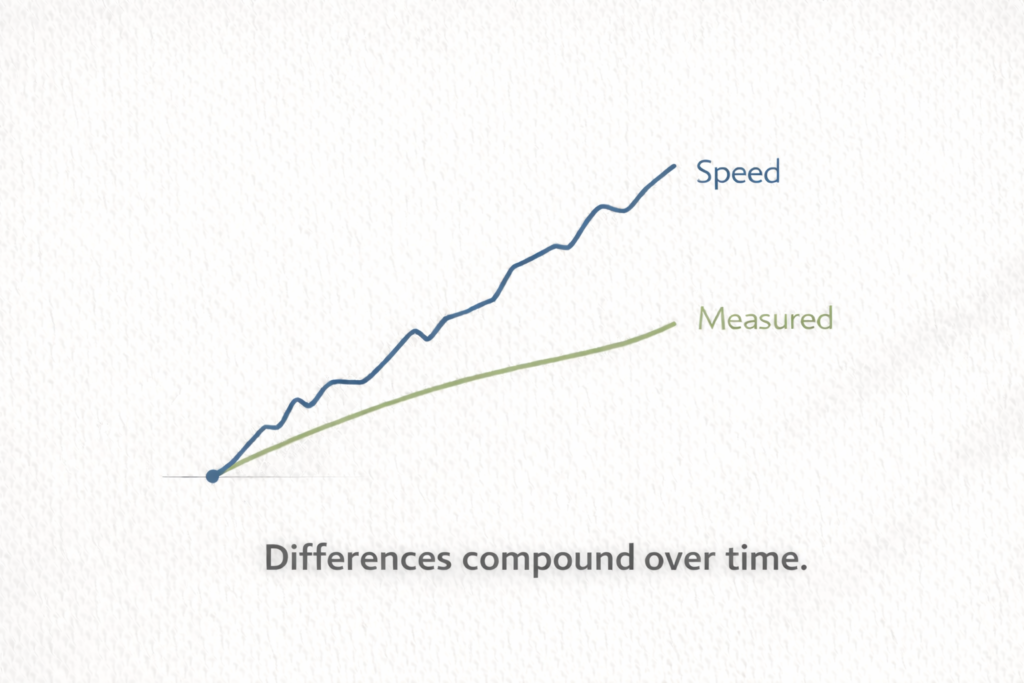
And over time, those differences compound.
So instead of trying to predict every possible outcome, it’s more useful to look at a few simple filters that tend to reveal how a partner will actually show up over time.
1. How do they define progress?
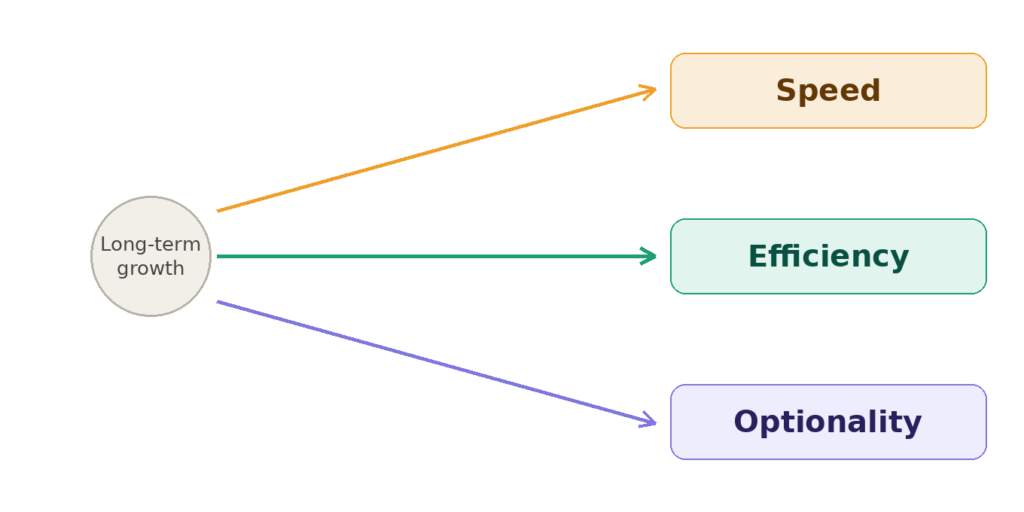
Every partner talks about growth.
But what they mean by growth can be very different.
Some measure it in speed.
Some in efficiency.
Some in optionality or long-term positioning.
The question isn’t whether they want the business to grow—it’s how they expect that growth to happen, and what they’re willing to be patient with along the way.
Because two people can say they’re aligned on “long-term growth” and still operate very differently when decisions need to be made.
2. What happens when performance dips?
You don’t see it in the pitch. You see it here.
Not in the pitch.
Not in the early conversations.
But in how a partner responds when things don’t go according to plan.
Do they slow down and ask better questions?
Do they step in and try to take control?
Do they stay steady, or does the tone shift?
You’re not just evaluating a partner’s ability to help you grow—you’re evaluating how they behave when growth slows.
That’s usually where alignment either holds or starts to break.
3. Where do they naturally create pressure?
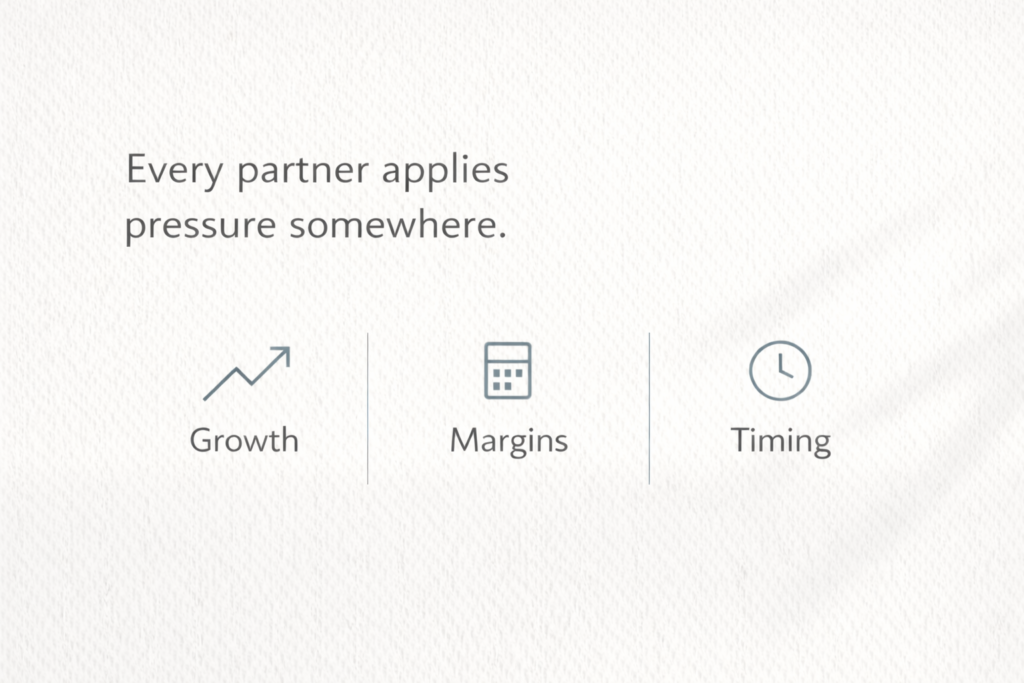
Every capital partner applies pressure somewhere.
Sometimes it’s toward faster growth.
Sometimes it’s toward tighter margins.
Sometimes it’s around timelines or exit expectations.
None of that is inherently wrong.
But it does matter where that pressure shows up—and whether it matches how you want to build.
Because even small differences here don’t stay small.
They compound over time.
4. What are they really optimizing for?
This doesn’t always get said directly, but it shows up in how decisions get made.
Some partners are optimizing for a specific exit window.
Some for consistent cash flow.
Some for building something that lasts beyond a single transaction.
You don’t need perfect alignment on everything.
But if you’re building for one outcome and your partner is quietly optimizing for another, it will create tension eventually.
What most founders miss
Most founders spend a lot of time evaluating how a partner will help them grow.
Far fewer spend time thinking about how that partner will respond when growth slows.
But that’s the part that tends to matter more over time.
Where partnerships actually break
Most partnerships don’t break because of a single disagreement or a bad decision.
They break more gradually.
One partner pushes for speed while the other wants to stay measured.
One sees a dip as part of the process, while the other sees it as something that needs to be corrected immediately.
One leans into uncertainty, while the other tries to control it.
Those differences aren’t always obvious early on.
But over time, they create friction—because each side is operating from a different set of assumptions about what matters.
And when that shows up under pressure, it’s much harder to work through.
The part that matters most
Most partnerships don’t break because of the deal itself.
They break more gradually—through a series of small moments where each side responds differently than the other expected.
When growth slows.
When decisions get harder.
When the path forward isn’t as clear.
That’s when assumptions start to surface.
And if those assumptions aren’t aligned, it creates friction that compounds over time.
The challenge is that you don’t see this clearly at the beginning.
But it’s the part of the partnership you’ll spend the most time in.
Which is why it’s worth paying attention to early—before you need it.