
Every leader knows the feeling.
You have someone on your team who is talented, capable, genuinely good at what they do, and you’ve put them in a role that doesn’t fit. Not because they failed. Not because they’re the wrong person. But because the seat doesn’t match the gift, and somewhere along the way it became clear that something has to change.
What you do next says everything about who you are as a leader.
The Situation Most Leaders Avoid
This isn’t a hypothetical for us. We’ve navigated this in one of our portfolio companies, and it’s the kind of situation that stays with you long after the conversation is over.
We had a team member who was brilliant. Talented. Someone we were genuinely fortunate to have. And we had put them in a role that their skill set didn’t fully fit, a seat that didn’t leverage what they did best. The mismatch wasn’t catastrophic. The work was getting done. But on a small team where every seat matters, a B-fit in a key role costs more than most leaders want to admit.
The easy path was to leave it alone. To tell ourselves it was good enough, that change was disruptive, that the timing wasn’t right. Most leaders stay in that place longer than they should, not because they don’t see the problem, but because doing something about it is genuinely hard.
We decided to do something about it.
The Harder Truth About Small Teams
Here’s what makes this particularly acute for the kinds of companies we work with: on small teams, you simply cannot afford to carry a role that isn’t firing on all cylinders.
This isn’t about being ruthless. It’s about being honest. When you allow someone to stay in a seat that doesn’t fit, even someone who is talented and well-meaning, you’re not just managing one person’s underperformance. You’re managing the morale, momentum, and productivity of everyone around them. The rest of your team sees it. They feel it. And over time, your tolerance for the mismatch sends a message about what standards actually look like in your organization.
The most caring thing a leader can do is create clarity, for the individual, and for the team.
What This Reveals About Your Culture
We talk a lot about culture at tKW Capital. But culture isn’t what you say in an all-hands meeting or post on a job description. It’s what you do when things are uncomfortable.
How you handle a personnel transition like this one, with honesty, with care, with genuine options and real conversations, tells your team more about who you are than any mission statement ever could. It tells them that when something hard happens to me here, I will be treated with dignity. I will be heard. I will not be blindsided or discarded.
That’s the kind of culture we’re trying to build. Not one where everything is easy, but one where the hard things are handled well.

Three Things We’re Keeping in Mind
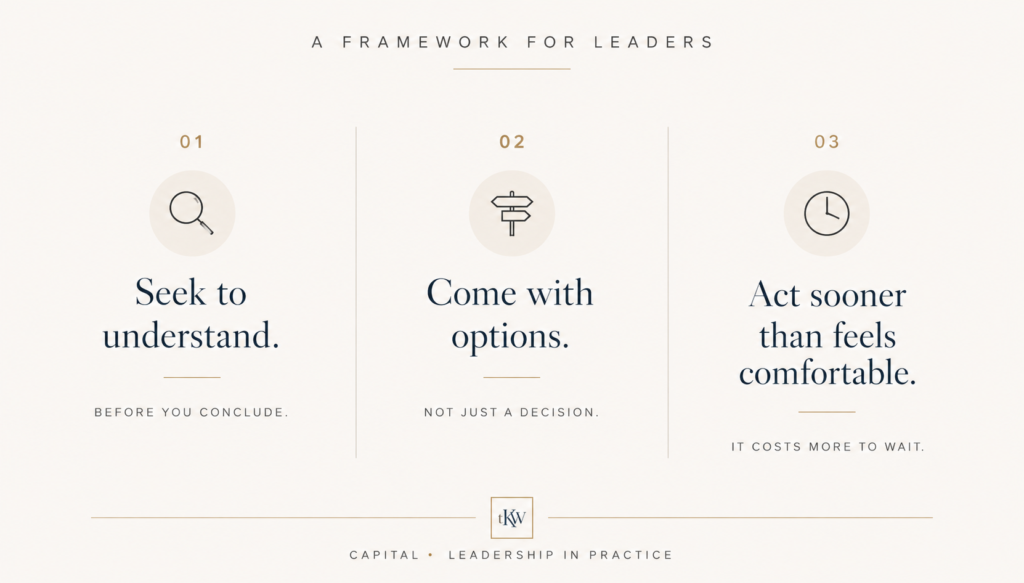
As we navigate these situations, here’s the framework we’re working from that is applicable to any leader facing a similar moment:
- Seek to understand before you conclude. Go into the conversation genuinely open. You may discover something you didn’t know: a gap in resources, a personal challenge, a miscommunication about expectations. Understanding doesn’t mean avoiding. It means being thorough.
- Come with options, not just a decision. Wherever possible, give the person agency in what comes next. It’s not always possible to keep someone in the organization, but when it is, explore it seriously. People remember how you tried.
- Act sooner than feels comfortable. The longer you wait, the more it costs the individual, the team, and the culture you’re trying to build. Doing the hard thing slowly isn’t the same as doing it kindly.
What the Delay Is Really Costing
How you treat the people who aren’t quite in the right seat is just as revealing as how you treat your top performers.
It’s easy to invest in the people who are thriving. The real test of your culture is what happens to the ones who aren’t, especially when it isn’t their fault.
The delay most leaders feel in these moments isn’t laziness. It’s usually care. Nobody wants to disrupt someone’s livelihood or have a hard conversation that might go badly. But that hesitation, left unchecked, quietly becomes its own kind of harm, to the individual, to the team, and to the culture you say you’re trying to build.
The most honoring thing you can do for someone in the wrong seat is to be honest with them sooner rather than later. Give them the chance to land somewhere they can actually thrive, whether that’s a different role inside your organization or a better opportunity somewhere else.
If someone on your team is talented but misplaced, what are you waiting for? And more importantly, what is that delay actually costing them?
tKW Capital acquires and grows blue-collar businesses between $3 and $5M in revenue. If you’re a business owner thinking about what comes next, or an investor looking to align your capital with your values, we’d love to connect.